

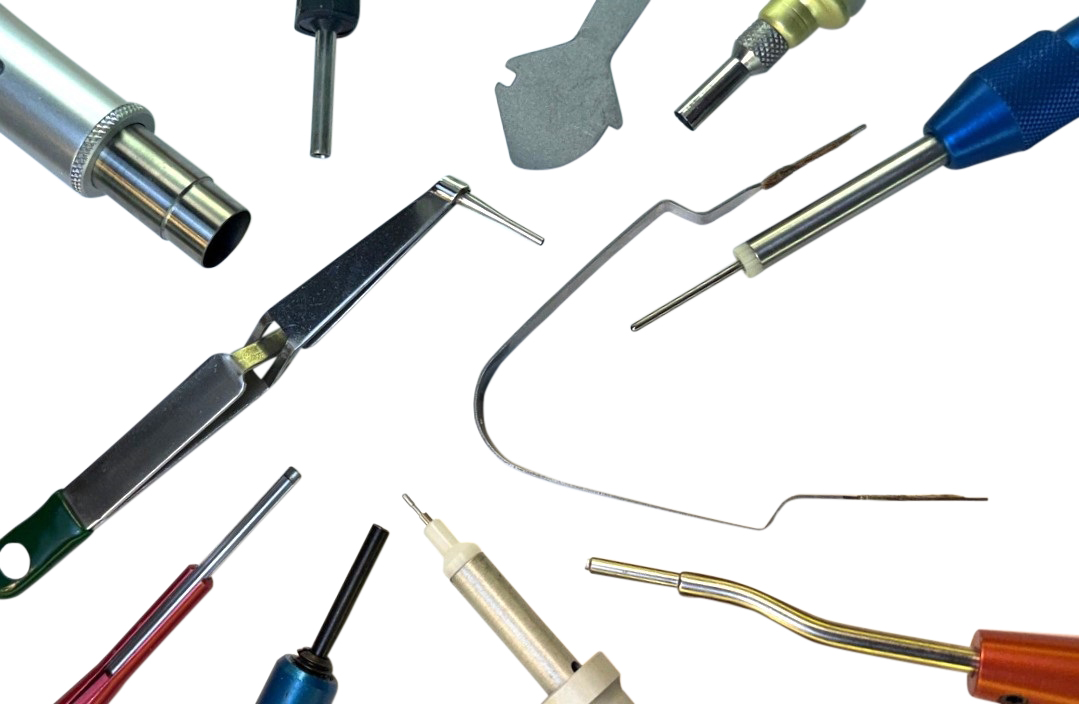
Metal Insertion & Removal Tools
Metal insertion and removal tools provide precise, reliable installation and extraction of electrical contacts in aerospace, defense, industrial, and high‑density connector systems. These tools are engineered for durability, accuracy, and long service life, making them essential for technicians working with mission‑critical wiring.
Connector Tooling LLC supplies professional‑grade metal tools designed to meet MIL‑spec and OEM requirements for contact handling.
What Metal Insertion & Removal Tools Do
Insertion and removal tools allow technicians to safely install or extract contacts from connector housings without damaging:
- The contact
- The connector cavity
- The wire insulation
- Adjacent contacts
These tools ensure:
- Proper seating depth
- Clean, damage‑free extraction
- Reduced risk of connector failure
- Compliance with MIL‑DTL and OEM specifications
They are essential for technicians working with high‑density, high‑value, or environmentally sealed connectors.
Types of Metal Insertion & Removal Tools
Metal Insertion Tools
Metal insertion tools are designed to guide and seat contacts into connector cavities with controlled alignment and minimal force.
Key Features
- Rigid metal construction for long service life
- Precision‑machined tips for accurate alignment
- Prevents bent contacts and damaged seals
- Suitable for high‑density and MIL‑spec connectors
- Ideal for repeated production or maintenance use
Typical Applications
- MIL‑DTL‑38999
- MIL‑DTL‑26482
- MIL‑DTL‑24308 (D‑Sub)
- High‑density circular and rectangular connectors
Metal Removal Tools
Metal removal tools allow technicians to extract contacts cleanly without deforming the connector cavity or damaging the retention mechanism.
Key Features
- Hardened metal blades for durability
- Positive engagement with contact retention clips
- Clean, controlled extraction
- Designed for repeated use in demanding environments
- Suitable for power, signal, and coaxial contacts
Typical Applications
- Repair and rework of MIL‑spec connectors
- Field maintenance and depot‑level service
- High‑density aerospace and defense wiring
- Industrial and commercial connector systems
Metal Insertion & Removal Tools – FAQ
What are metal insertion and removal tools used for?
These tools are designed to install and extract electrical contacts from connector housings without damaging the contact, cavity, or retention mechanism. They ensure clean, reliable work on MIL‑spec, aerospace, industrial, and high‑density connectors.
Why use metal tools instead of plastic ones?
Metal tools offer superior durability, precision, and longevity. They maintain their shape under repeated use, making them ideal for production environments, depot‑level maintenance, and high‑density connectors where accuracy is critical.
How do metal insertion tools work?
Insertion tools guide the contact straight into the connector cavity, preventing bent contacts, damaged seals, or misalignment. They ensure the contact seats fully and engages the retention clip correctly.
How do metal removal tools work?
Removal tools release the retention clip inside the connector, allowing the contact to slide out cleanly. They prevent gouging, scraping, or deforming the connector cavity—common issues when using improvised tools.
Are these tools compatible with MIL‑spec connectors?
Yes. Metal insertion and removal tools are commonly used with MIL‑DTL‑38999, 26482, 24308 (D‑Sub), 5015/AS50151, and other military‑grade connector families.
Can one tool work for multiple contact sizes?
Some tools are size‑specific, while others support multiple contact sizes depending on the connector series. Always match the tool to the contact size (e.g., size 20, 16, 12) for proper engagement.
Do insertion and removal tools require maintenance?
Minimal maintenance is needed. Keep the tips clean, avoid bending the blades, and store the tools in protective sleeves. Metal tools last significantly longer than plastic alternatives when handled properly.
Can these tools be used in field service environments?
Absolutely. Metal tools are rugged, reliable, and ideal for field repairs, aircraft maintenance, industrial service calls, and any situation where precision and durability matter.
What happens if I use the wrong tool?
Using an incorrect tool can damage the connector cavity, deform the retention clip, or bend the contact. This can lead to intermittent electrical issues or complete connector failure. Always match the tool to the contact and connector series.